Platform

Pedion

Materials property analysis

Functional property analysis from the governing relations, not from an unconstrained curve.

Pedion is a set of dedicated engines, one per measurement class. Magnetocaloric analysis uses the Maxwell relation on the measured isotherms. Thermoelectric quantities are assembled only at temperatures that were measured. Piezoelectric coefficients keep the distinction between d₃₃* and d₃₃. Dielectric, ferroelectric, and electrocaloric response share the same geometry as the figure. Voltammetry is treated as electrochemistry, not as a plot macro.

Standard workflows routinely lose metadata during unit scaling and manual spreadsheet transfers. Traditionally, an instrument file is first processed into readable data and organized through vendor GUIs, spreadsheets and python only then a researcher will be able to put property specific mathematical calculations to derive the parameters which usually fall under large error margins. Pedion automates property extraction directly from raw instrument outputs—enforcing property specific physical boundary conditions and generating fully traceable calculation logs for every exported result. Reducing materials property evaluation time from hours to just a few mins.

Pedion

Voltance

Cyclic voltammetry, galvanostatic cycling, incremental capacity, impedance and GITT — classified as techniques, not as spreadsheets.

Voltance will not invent a diffusion coefficient when n or bulk concentration were never entered. It will not invert coulombic efficiency on an anode because the current column looks the wrong way. Incremental capacity is Savitzky–Golay, never a raw difference of a 10⁵-point file. Anodes report first-cycle CE as Qdelithiation/Qlithiation. Randles–Ševčík D and GITT D are withheld rather than decorated when the inputs are blank.

  • Parsers for Bio-Logic, Gamry, Neware, Arbin, Maccor and CHI as electrochemistry, not as CSV
  • Literature conventions for anode versus cathode first-cycle coulombic efficiency
  • ICA with documented smoothing and named staging / H2–H3 features tracked against aging
  • Nyquist fits that refuse a Warburg D invented from σ alone
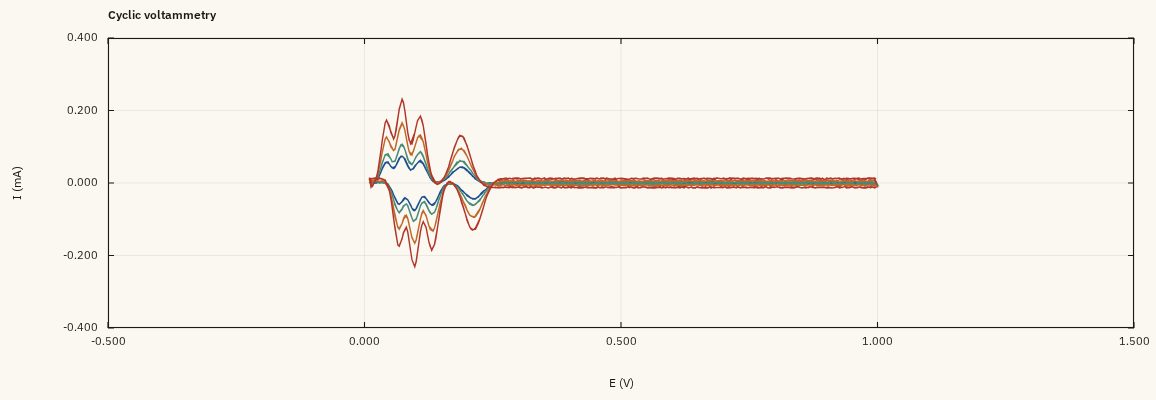
Cyclic voltammetry of graphite vs Li at four scan rates. Staging peaks sharpen on the reduction sweep; rectangularness is low — a battery electrode, not an EDLC.

CaloMag

Maxwell ΔSM, Banerjee classification and RCP on one grid, so a mistake in mass or branch appears everywhere at once.

CaloMag is a dedicated thermodynamic engine for PPMS VSM isotherms. After mass normalisation it treats the isotherm grid as the thermodynamic object, classifies M–H versus M–T from column variation, and evaluates Maxwell ΔSM, RCP, ΔCp, Banerjee on Arrott plots, and critical exponents from modified Arrott, Kouvel–Fisher and power-law scaling. Mean-field scaling is flagged, not pretended, on a discontinuous transition.

  • Native MultiVu parse; Time, T, H, M identified; mass normalisation that never overwrites the raw file
  • Maxwell ΔSM, FWHM, RCP and ΔCp = T (∂ΔSM/∂T)H on the same grid
  • Banerjee criterion and MAP / Kouvel–Fisher / power-law exponents with β, γ adjustable
  • Gd (SOMT) and La(Fe,Si)₁₃ (FOMT) demonstrations so the two working-fluid families can be read side by side
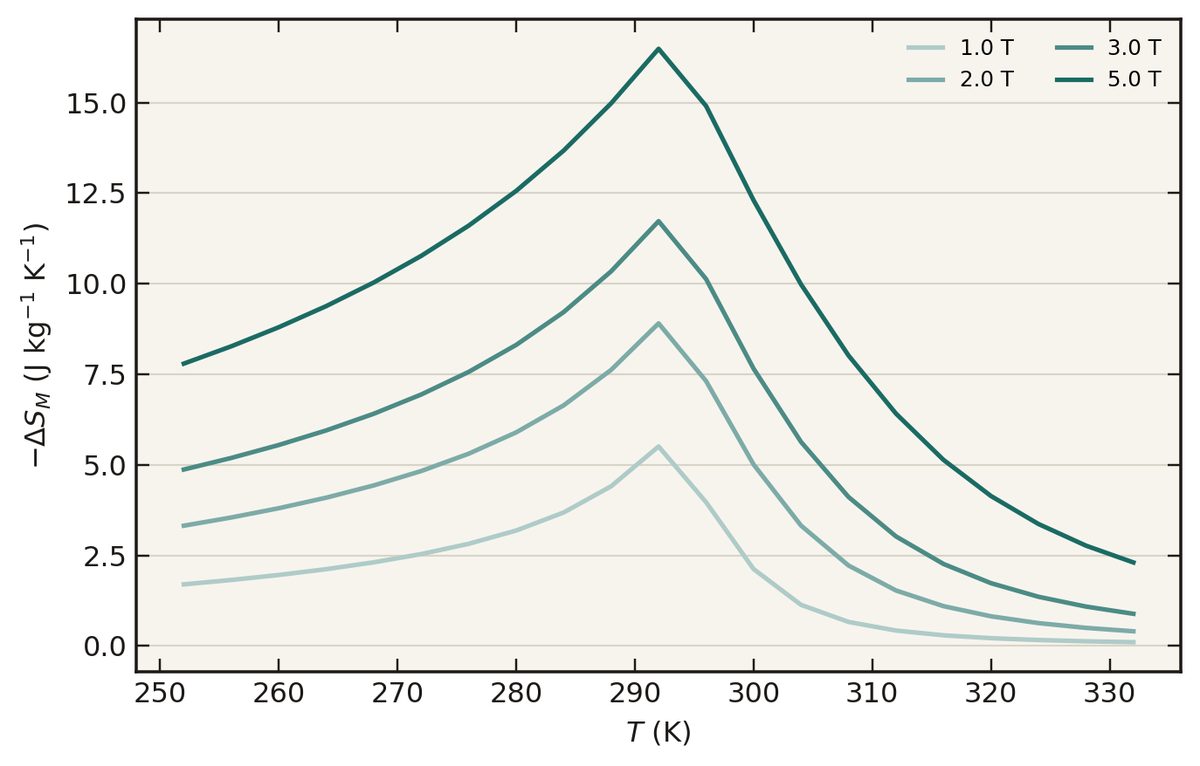
Iso-field −ΔSM(T) on the Gd demonstration. The peak sits at TC, broadens with field, and remains symmetric — the signature of a continuous ferromagnetic transition.

ThermoCal

A thermoelectric quantity is defined where it was measured. Linear extrapolation past the last laser-flash temperature is a claim about physics that nobody made.

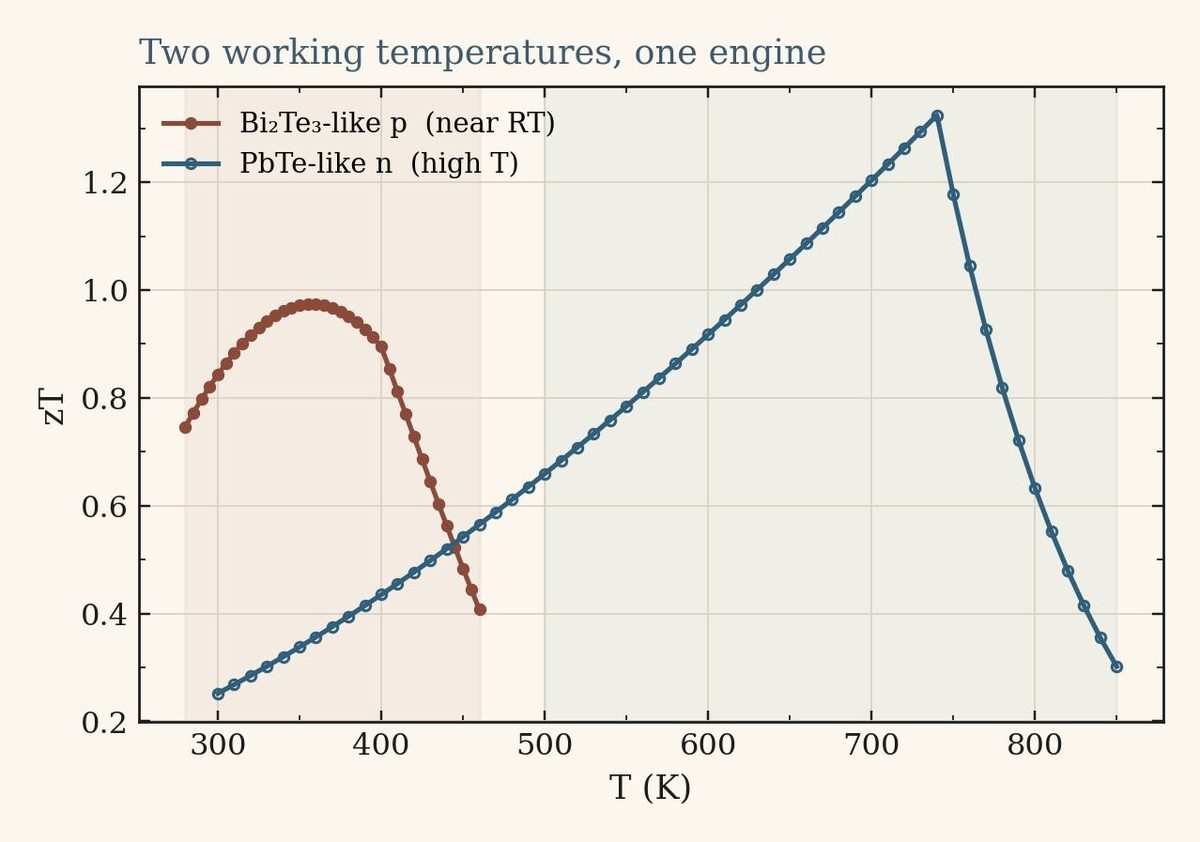
ThermoCal treats assembly as an instrument. It builds the T-grid on the overlap of the loaded series. If κ stops at 773 K, zT stops at 773 K. The PF–zT tab will show a power factor without a zT until κ arrives. A dashed zT is not drawn. Provenance sits on every cell: measured, interpolated onto the grid, or absent. Lorenz and Th/Tc corrections are explicit, not tribal knowledge.

  • No extrapolation, on principle — zT lives only on the overlap of S, ρ and κ
  • Provenance on every assembled cell; the worksheet is live, not an export
  • Lorenz number and Thomson/Peltier bookkeeping stated rather than assumed
  • Origin-style paper plots: margins, dual axes, closed/open symbols, captions
Figure of merit from the built-in demos, drawn by the same engine the session opens. Bi₂Te₃-like p-type near room temperature; PbTe-like n-type at high T. zT lives only on the overlap of S, ρ and κ.

Piezoic

d₃₃* is not d₃₃. keff is a privilege, not a formula. Geometry is live.

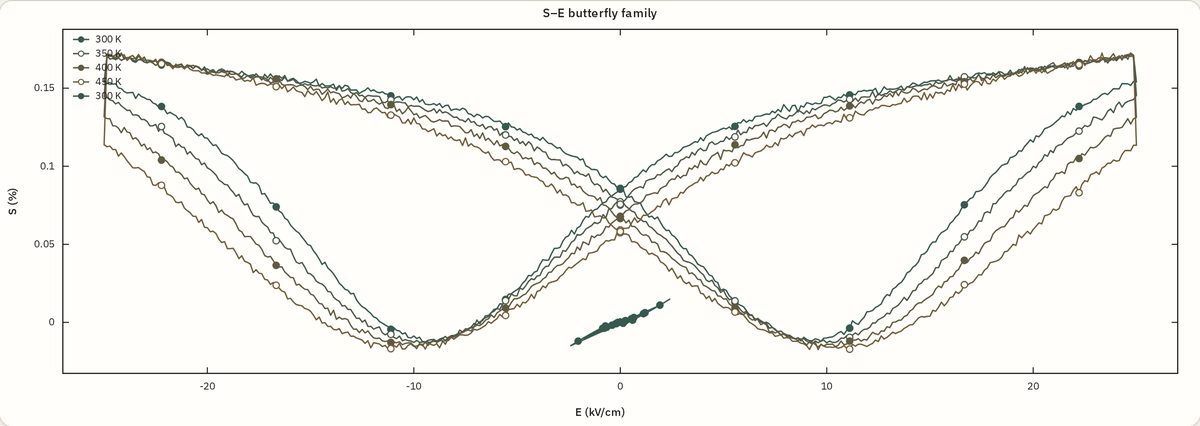
Piezoic inverts that order. Geometry is a first-class object. Every derived quantity carries its definition: d₃₃* is labelled large-signal; the high-field slope of a unipolar S–E loop is the only S–E number allowed to stand next to a Berlincourt reading; keff is withheld when the resonator is overdamped, sparse, or non-resonant. A 15 % disagreement between d₃₃* and constitutive d₃₃ raises a flag. High d·g, high k² and high Qm are three different optima.

  • S–E and P–E families sharing specimen geometry, so S(P) and electrostriction tests are rearrangements, not a second experiment
  • IEEE 176 / EN 50324 resonance with keff withheld when the resonator is not actually resonant
  • Berlincourt d₃₃(T) with heat/cool Td and hysteresis called out rather than hidden
  • Rayleigh dinit + α E₀ on subcoercive minors as a quantitative signature of domain-wall mobility
Soft PZT-5H analogue. Bipolar S–E family, 300–450 K. Remnant strain is a substantial fraction of Smax and the wings dip: ferroelastic switching, not a linear dielectric.

DielCal

Permittivity, polarisation and electrocaloric response with the geometry sitting on the same page as the figure.

DielCal is a single session for LCR, P–E and Maxwell electrocalorics. Novocontrol, Keysight, Radiant, AixACCT and PPMS streams parse without a hand-built column map. Electrode area, gap, density and specific heat are sliders: change d and E, P, ε′ and ΔSE move. The engine classifies proper ferroelectric, relaxor, linear dielectric, or Maxwell–Wagner artefact. A narrow |ΔS|(T) on a steep P(T) drop is first-order-like, and Maxwell is not allowed to travel without that warning.

  • Instrument-native import and live geometry so ε′, E and P update with A and d
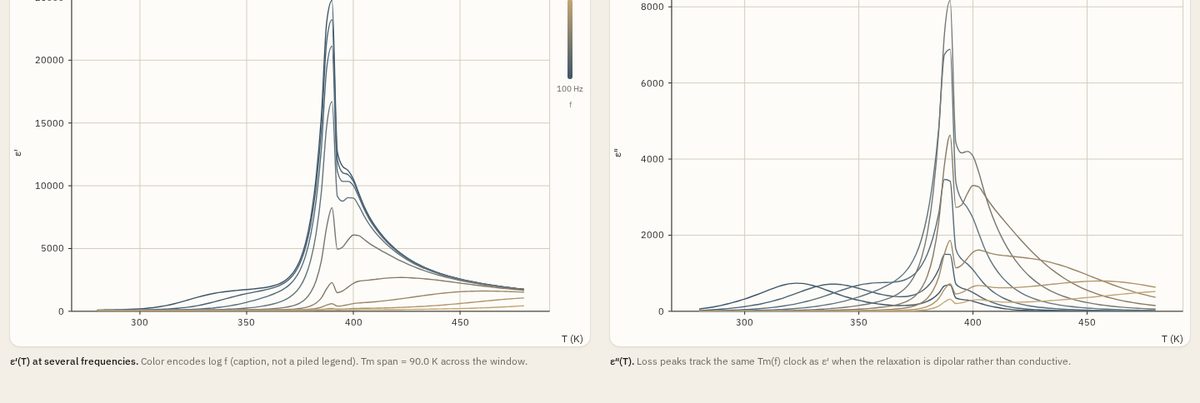
  • Isofrequency ε′(T, f) with log frequency as colour, not a piled legend
  • P–E loops with Pr, Ec, Urec and η; pinched or leaky loops flagged rather than silently integrated
  • Indirect Maxwell −ΔSE and ΔTad with a first-order coexistence warning
Isofrequency ε′(T) for the BaTiO₃ analogue. Colour encodes log frequency; the caption reports the Tm span rather than a legend of ten traces.

Voltance

Cyclic voltammetry, galvanostatic cycling, incremental capacity, impedance and GITT — classified as techniques, not as spreadsheets.

Voltance will not invent a diffusion coefficient when n or bulk concentration were never entered. It will not invert coulombic efficiency on an anode because the current column looks the wrong way. Incremental capacity is Savitzky–Golay, never a raw difference of a 10⁵-point file. Anodes report first-cycle CE as Qdelithiation/Qlithiation. Randles–Ševčík D and GITT D are withheld rather than decorated when the inputs are blank.

  • Parsers for Bio-Logic, Gamry, Neware, Arbin, Maccor and CHI as electrochemistry, not as CSV
  • Literature conventions for anode versus cathode first-cycle coulombic efficiency
  • ICA with documented smoothing and named staging / H2–H3 features tracked against aging
  • Nyquist fits that refuse a Warburg D invented from σ alone
Cyclic voltammetry of graphite vs Li at four scan rates. Staging peaks sharpen on the reduction sweep; rectangularness is low — a battery electrode, not an EDLC.

CaloMag

Maxwell ΔSM, Banerjee classification and RCP on one grid, so a mistake in mass or branch appears everywhere at once.

CaloMag is a dedicated thermodynamic engine for PPMS VSM isotherms. After mass normalisation it treats the isotherm grid as the thermodynamic object, classifies M–H versus M–T from column variation, and evaluates Maxwell ΔSM, RCP, ΔCp, Banerjee on Arrott plots, and critical exponents from modified Arrott, Kouvel–Fisher and power-law scaling. Mean-field scaling is flagged, not pretended, on a discontinuous transition.

  • Native MultiVu parse; Time, T, H, M identified; mass normalisation that never overwrites the raw file
  • Maxwell ΔSM, FWHM, RCP and ΔCp = T (∂ΔSM/∂T)H on the same grid
  • Banerjee criterion and MAP / Kouvel–Fisher / power-law exponents with β, γ adjustable
  • Gd (SOMT) and La(Fe,Si)₁₃ (FOMT) demonstrations so the two working-fluid families can be read side by side
Iso-field −ΔSM(T) on the Gd demonstration. The peak sits at TC, broadens with field, and remains symmetric — the signature of a continuous ferromagnetic transition.

On this platform

Laboratories