

DielCal
LiveDielectric, ferroelectric and electrocaloric analysis in one session
Permittivity, polarisation and electrocaloric response with the geometry sitting on the same page as the figure.
A typical dielectric or ferroelectric campaign still ends in Excel, Origin, and MATLAB because Curie–Weiss, Vogel–Fulcher and Maxwell ΔSE were never in last year’s template. P–E lives in a second notebook. Energy storage is a third integral. By the time the figure is presentable, the geometry, the frequency window and the reason the run was taken have all drifted.
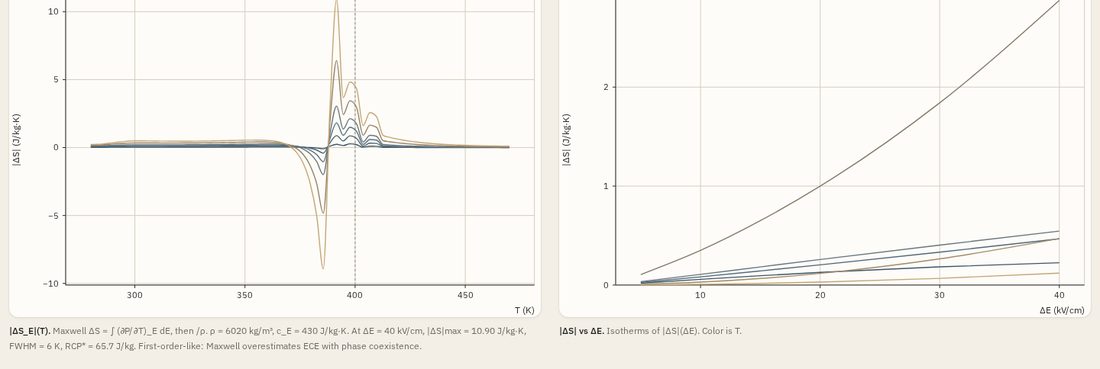
DielCal is a single session for LCR, P–E and Maxwell electrocalorics. Novocontrol, Keysight, Radiant, AixACCT and PPMS streams parse without a hand-built column map. Electrode area, gap, density and specific heat are sliders: change d and E, P, ε′ and ΔSE move. The engine classifies proper ferroelectric, relaxor, linear dielectric, or Maxwell–Wagner artefact. A narrow |ΔS|(T) on a steep P(T) drop is first-order-like, and Maxwell is not allowed to travel without that warning.
What it does
- Instrument-native import and live geometry so ε′, E and P update with A and d
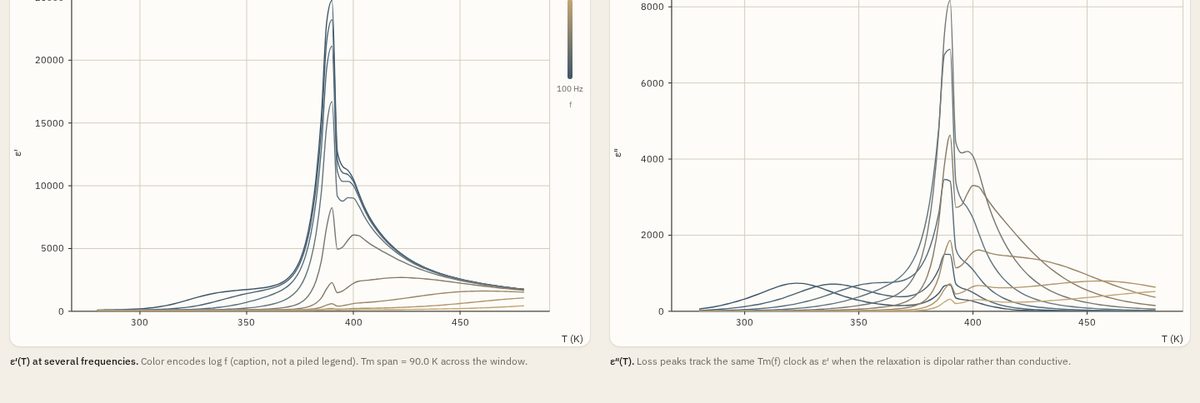
- Isofrequency ε′(T, f) with log frequency as colour, not a piled legend
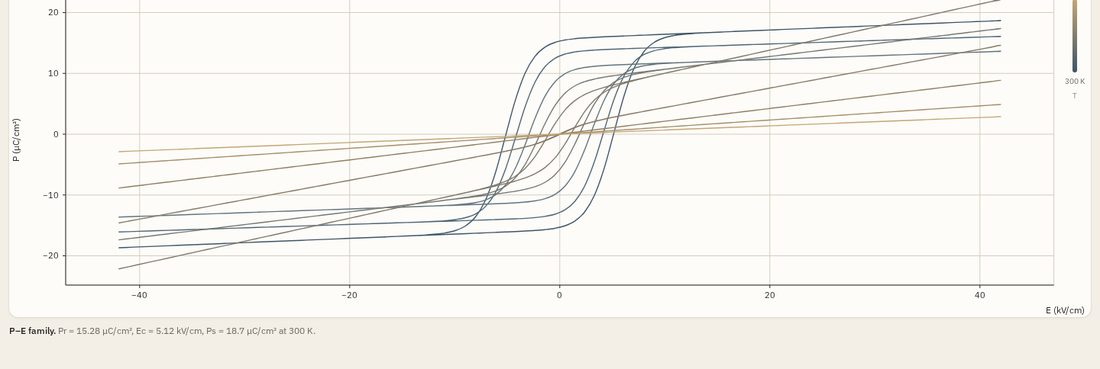
- P–E loops with Pr, Ec, Urec and η; pinched or leaky loops flagged rather than silently integrated
- Indirect Maxwell −ΔSE and ΔTad with a first-order coexistence warning
- Modified Curie–Weiss γ; Arrhenius and Vogel–Fulcher Tm(f); Cole–Cole, Nyquist and Bode in the same worksheet