

CaloMag
LiveMagnetocaloric analysis of PPMS VSM isotherms
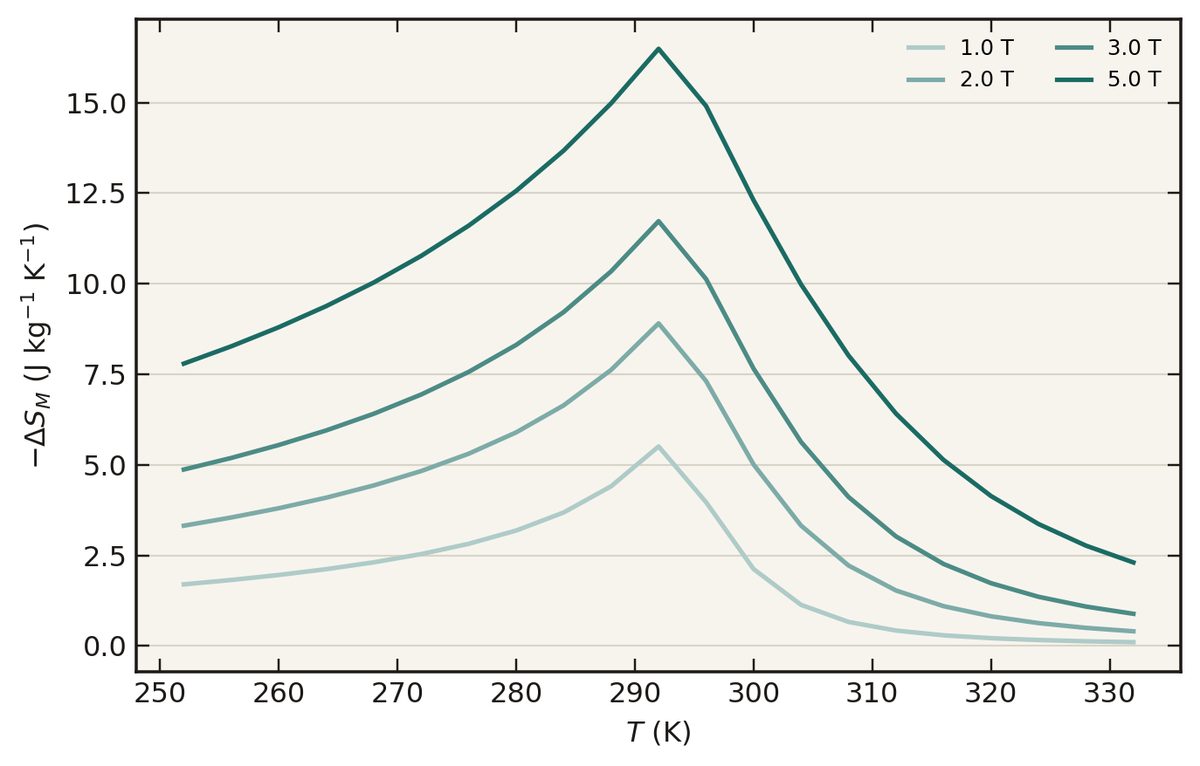
Maxwell ΔSM, Banerjee classification and RCP on one grid, so a mistake in mass or branch appears everywhere at once.
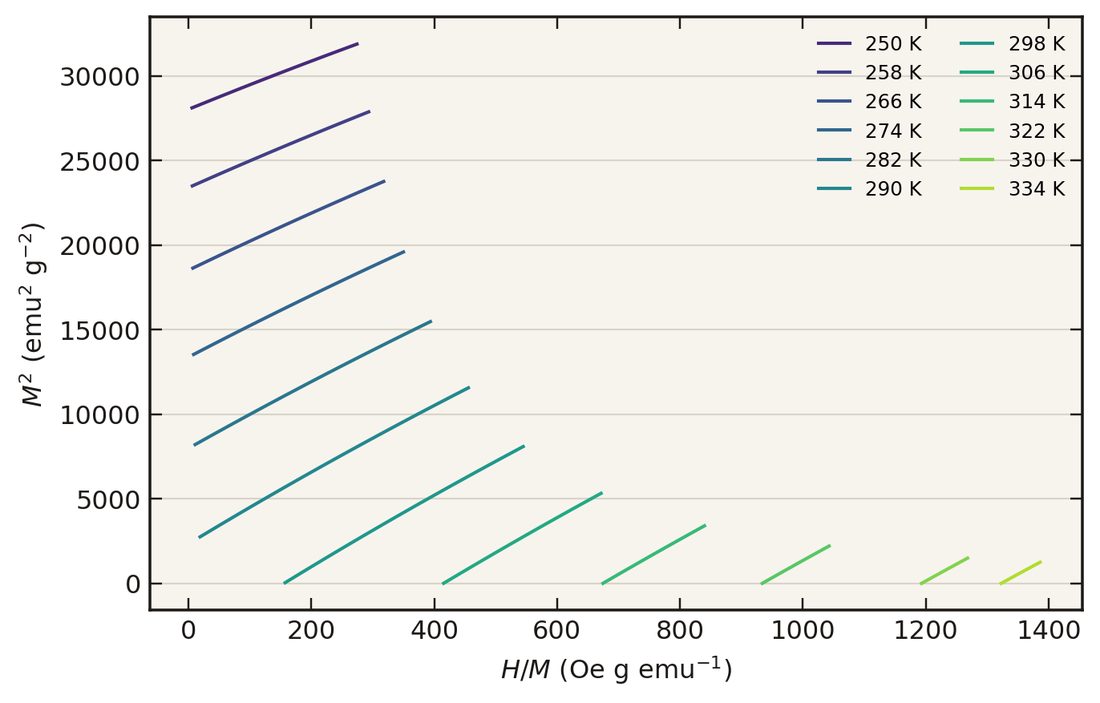
A conventional magnetocaloric reduction is a chain of hand-offs. One skips the PPMS header, splits isotherms, converts emu to emu g⁻¹, interpolates onto a field grid, evaluates ΔSM, then rebuilds Arrott plots and refrigerant capacity as separate worksheets. Origin and Python will draw what the operator already understands. They do not know that a negative Arrott slope is a first-order warning rather than a fitting glitch.
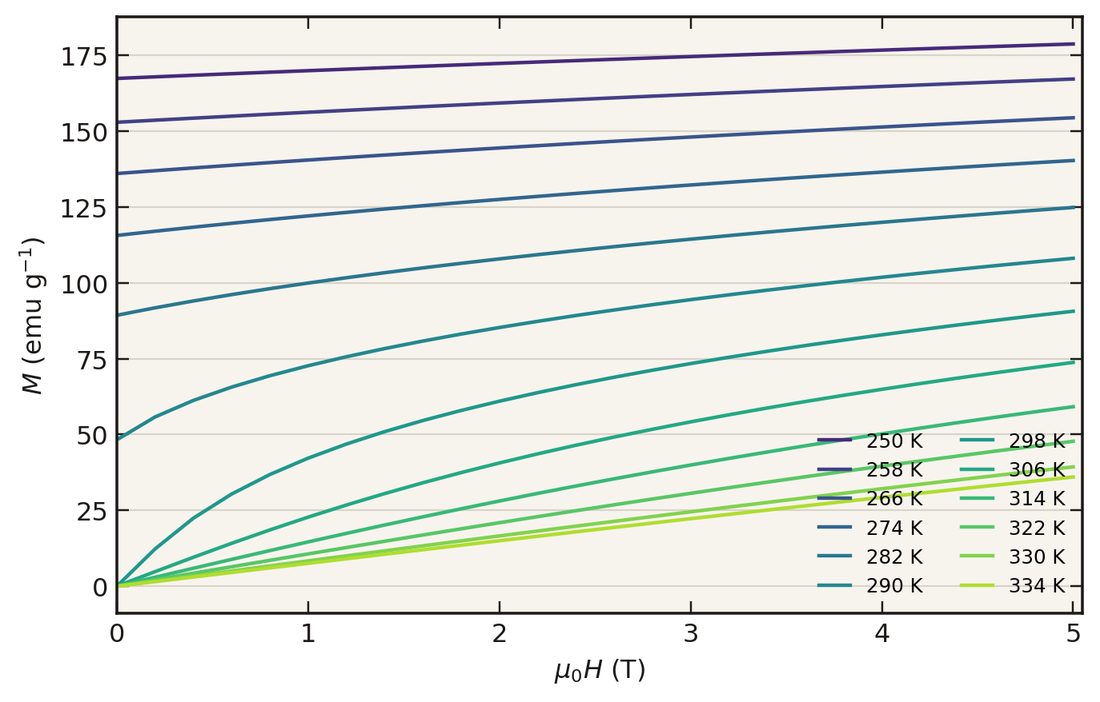
CaloMag is a dedicated thermodynamic engine for PPMS VSM isotherms. After mass normalisation it treats the isotherm grid as the thermodynamic object, classifies M–H versus M–T from column variation, and evaluates Maxwell ΔSM, RCP, ΔCp, Banerjee on Arrott plots, and critical exponents from modified Arrott, Kouvel–Fisher and power-law scaling. Mean-field scaling is flagged, not pretended, on a discontinuous transition.
What it does
- Native MultiVu parse; Time, T, H, M identified; mass normalisation that never overwrites the raw file
- Maxwell ΔSM, FWHM, RCP and ΔCp = T (∂ΔSM/∂T)H on the same grid
- Banerjee criterion and MAP / Kouvel–Fisher / power-law exponents with β, γ adjustable
- Gd (SOMT) and La(Fe,Si)₁₃ (FOMT) demonstrations so the two working-fluid families can be read side by side
- Origin-like figures and a reopenable .calomag.json; data never leave the machine