
Warp
LiveVirtual laboratory for designing and optimizing the experiments
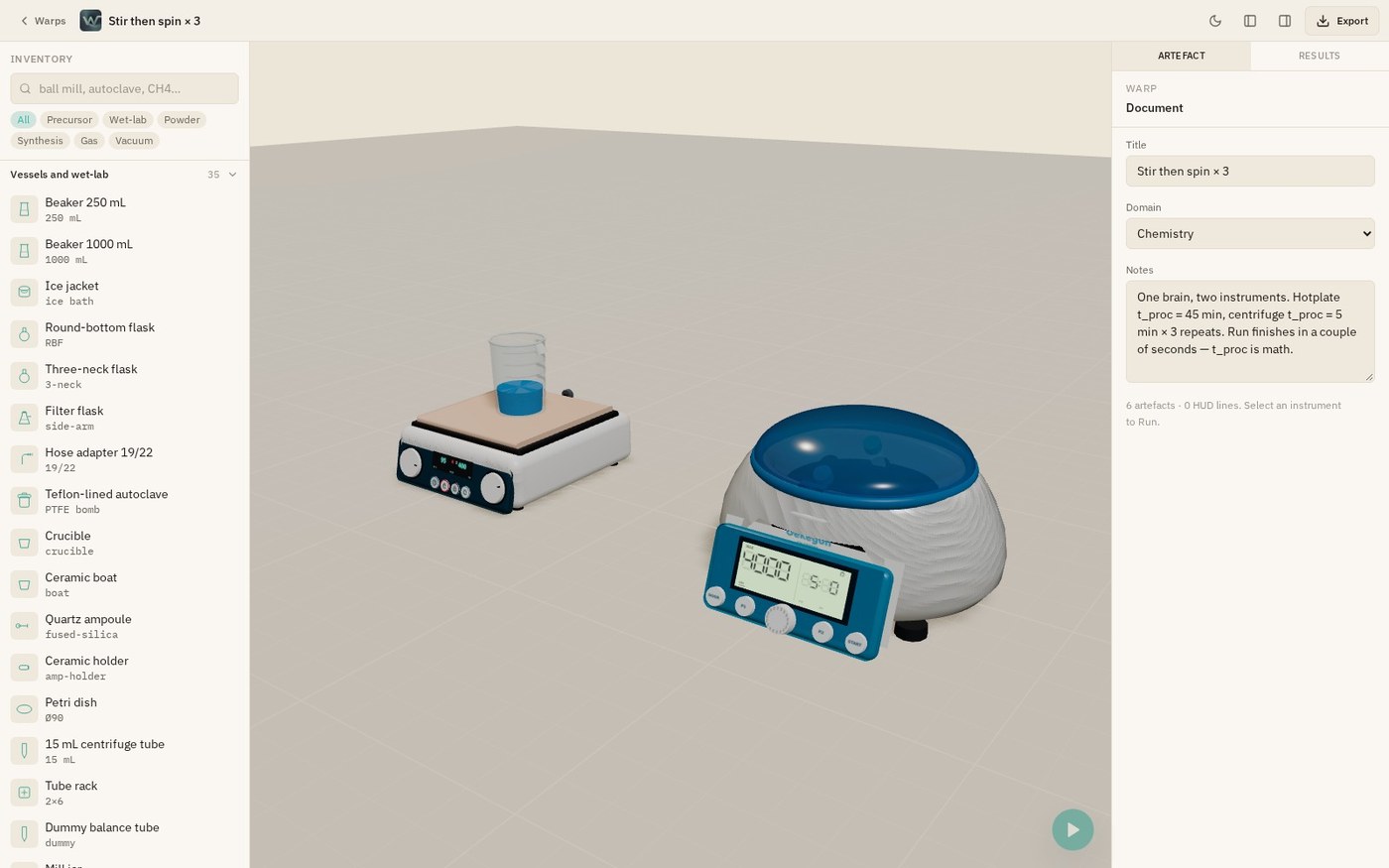
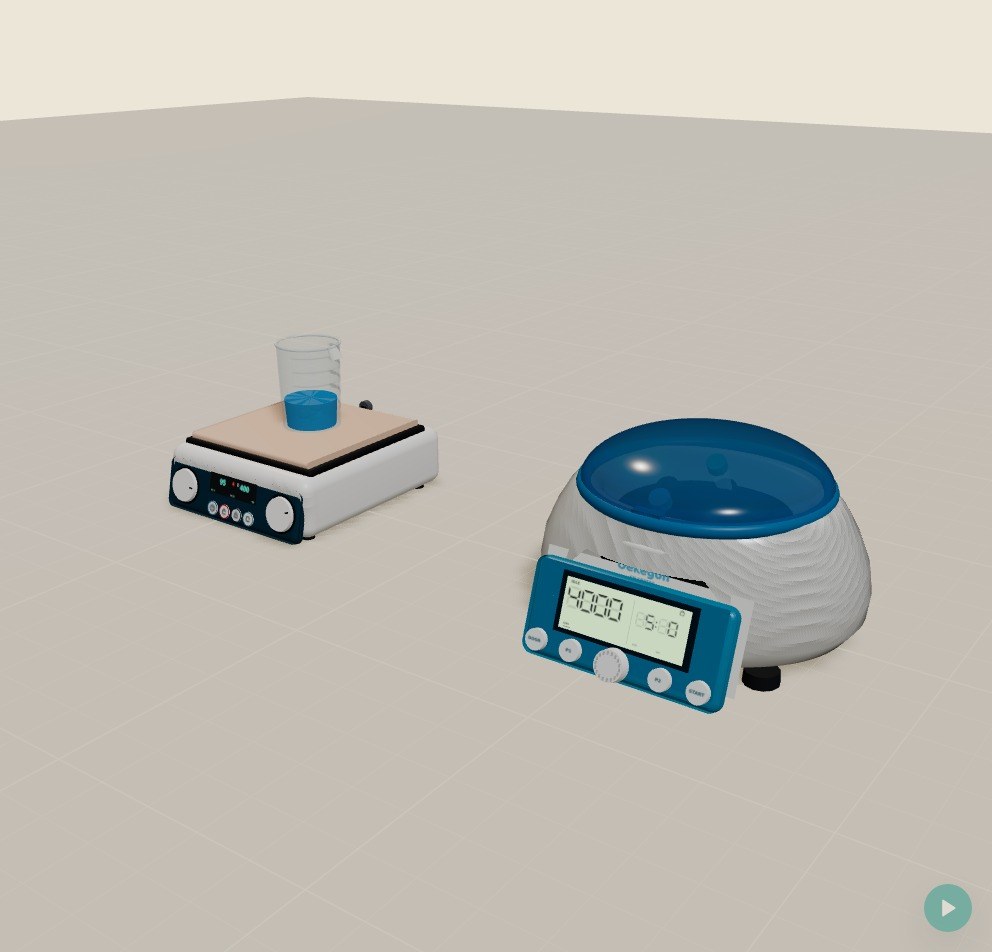
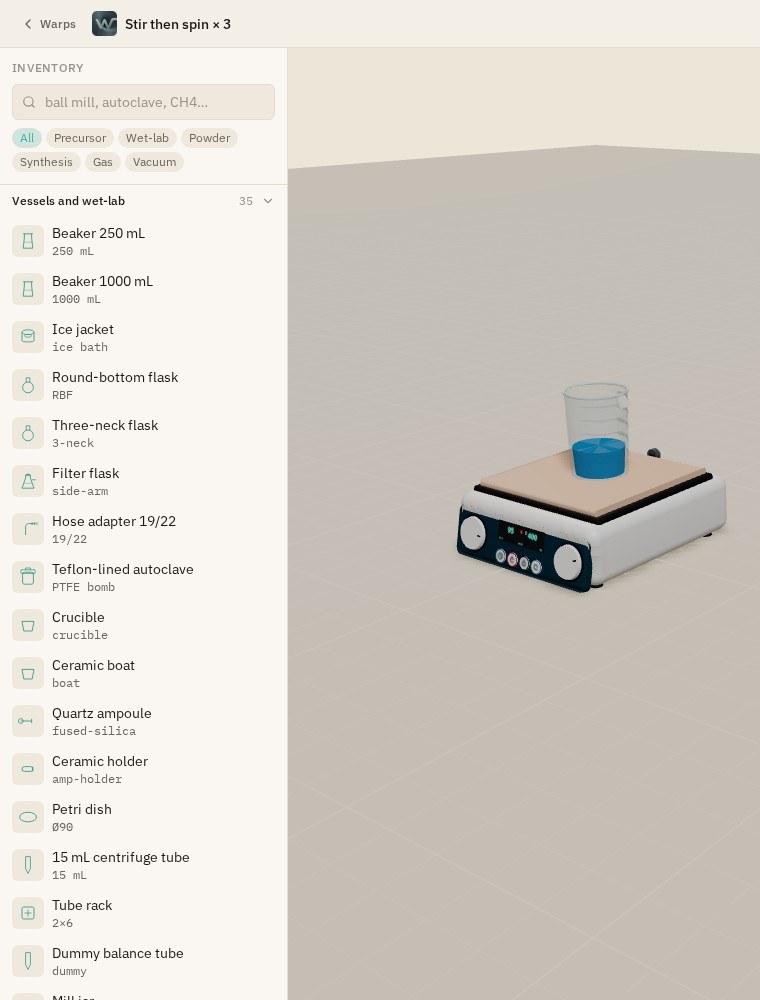
Minute modifications in the experimental process can change the materials property drastically, in the current laboratory practices the researchers spent countless hours and weeks optimizing experimental protocols to get desired phases and properties. In most of the cases this procedure is not always very fruitful. With Warp we are committed to end that era of experimentation. Warp shifts protocol design into a CAD style 3D Virtual workbench, enabling researchers to configure synthesis apparatus, verify instrument parameters, optimize concentrations and experiment variable before stepping into the actual work bench.
Warp embeds domain-specific physical rules directly into the workspace geometry-automatically refusing invalid operations such as joint size mismatches, ground glass fittings, overfilled hydrothermal vessels, unbalanced centrifuge loads, or unsealed thermal processing environments.
Every virtual run processes experimental parameters through strict conservation algorithms:
sampleout = F(samplein, vars, tproc)
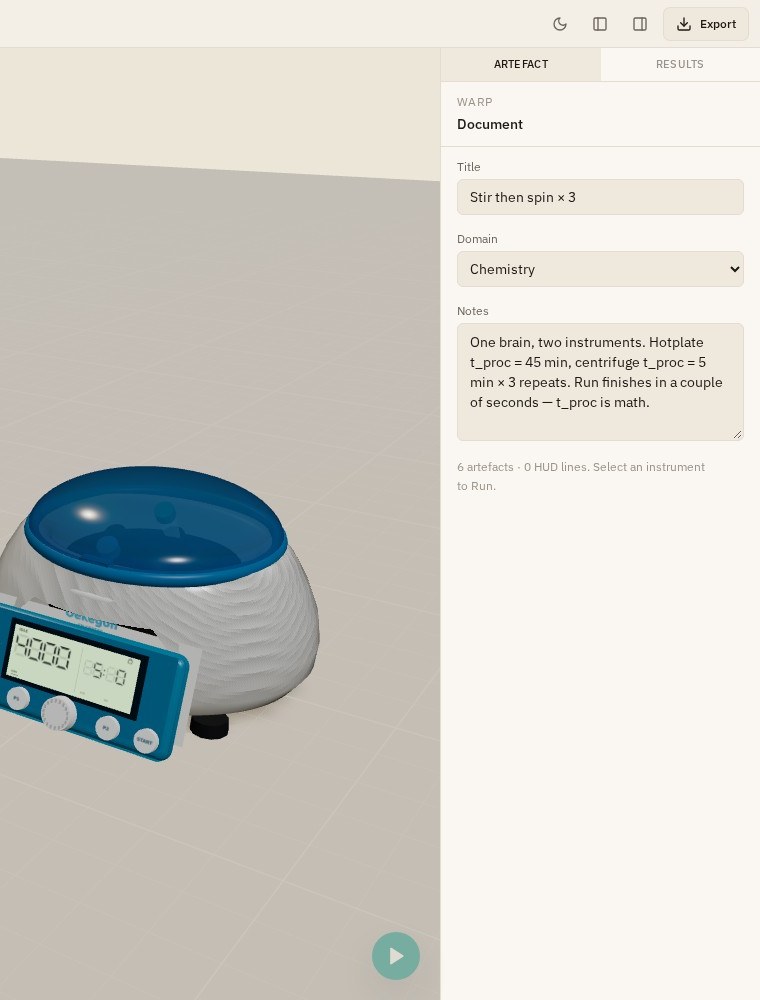
Reactions, phase transformations, and mass balance are governed by listed thermodynamic conversion pathways and kinetic models rather than unconstrained generative text. F is the first-principles calculation function that Warp employs and writes sample state on a successful run, ledger is the notebook that feeds variable to F, AI reads F function to give opinion on your virtual experiment. So, Warp ensures that stoichiometric limits, precipitation kinetics, and process time parameters remain fully conserved and reproducible.
| Feature | Legacy synthesis planning | The Warp 3D environment |
|---|---|---|
| Setup Validation | Trial-and-error at the bench; manual protocol translation. | Kinematic Interlocks: Automatically flags joint mismatches, volume fill limits, and rotor mass imbalances. |
| Reaction Modeling | Static notebook records or unconstrained text prompts. | Conserved Physics (F): Enforces stoichiometric limiting reagents, solubility limits, and listed thermal pathways. |
| Documentation | Time-consuming manual ELN entry. | Automated Audit Logs: Generates transparent execution ledgers and notebook summaries instantly upon execution. |