Spectrum Desk
LiveChemically Constrained Deconvolution & Spectral Analysis
Fit peaks the physics allows. Rank the alternatives. Leave assignments unwritten when the spectrum cannot support it.
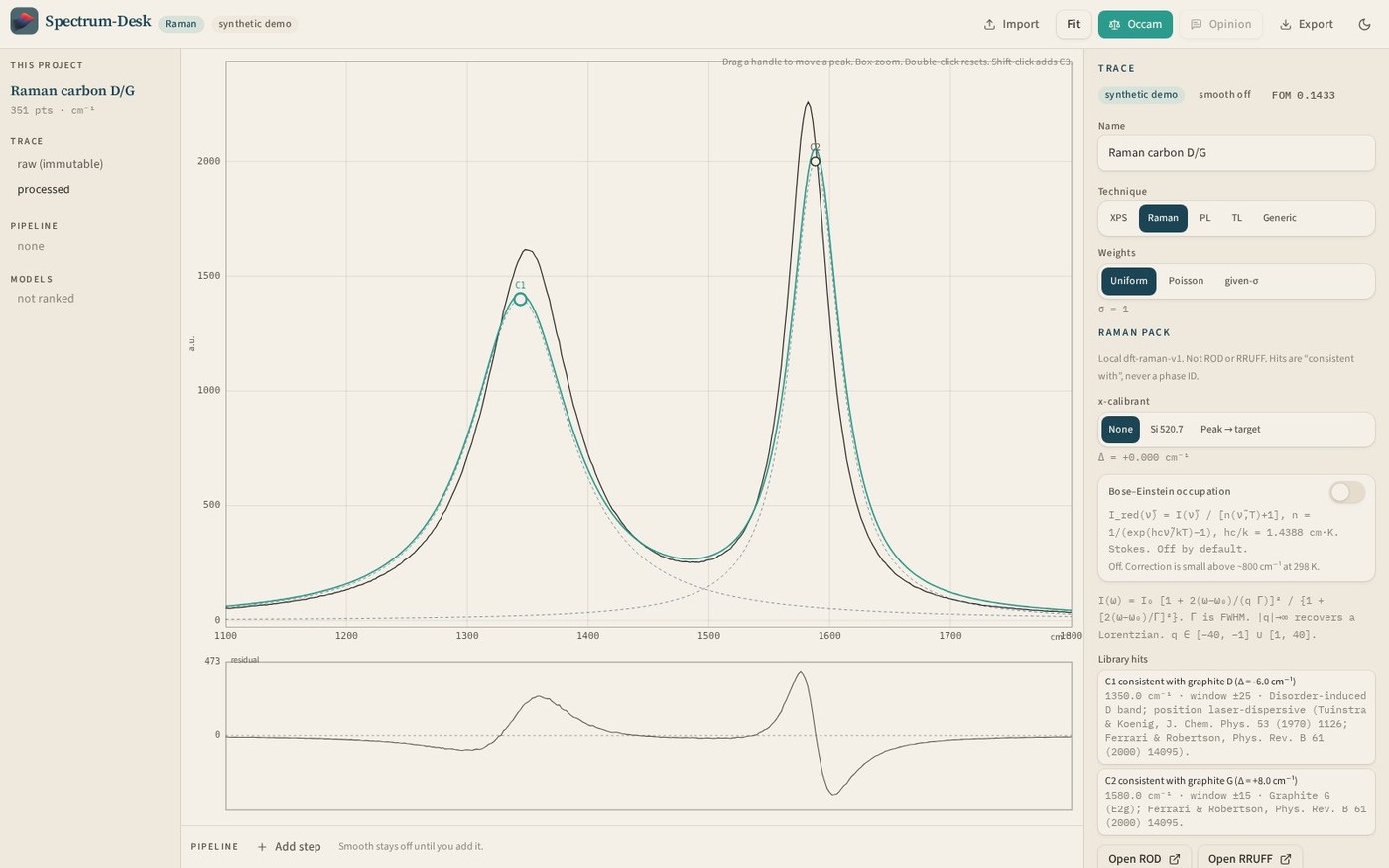
Ordinary analysis software will add a peak because the residual looks quieter. Origin, CasaXPS, and PeakFit will raise R² if asked. A third Gaussian under a defect band, a label next to a centroid, and a figure that then reads as chemistry are treated as the result. Numbered peaks become assignments.
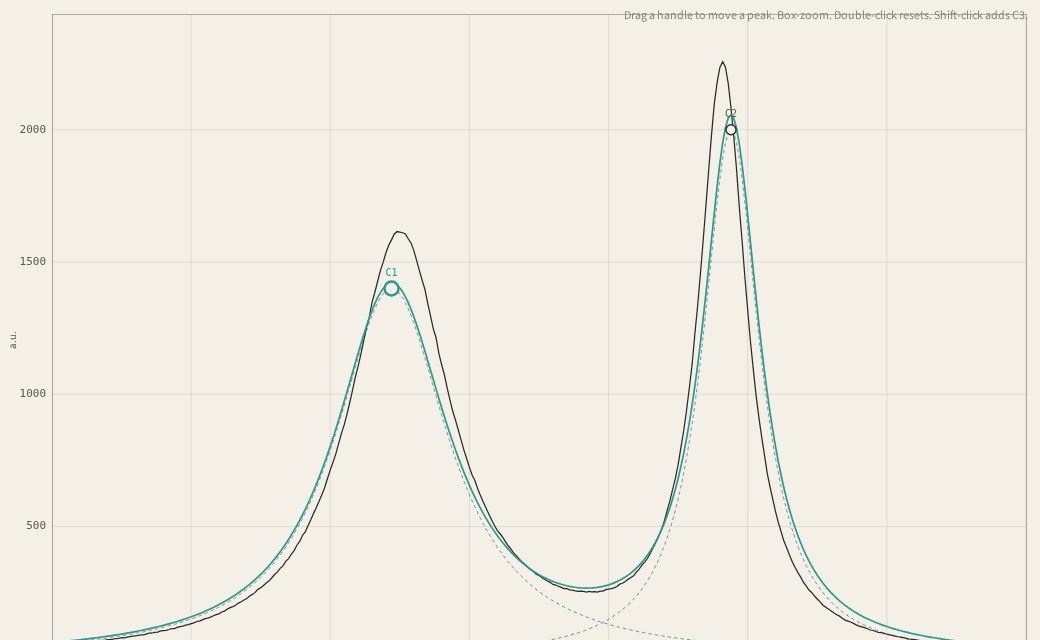
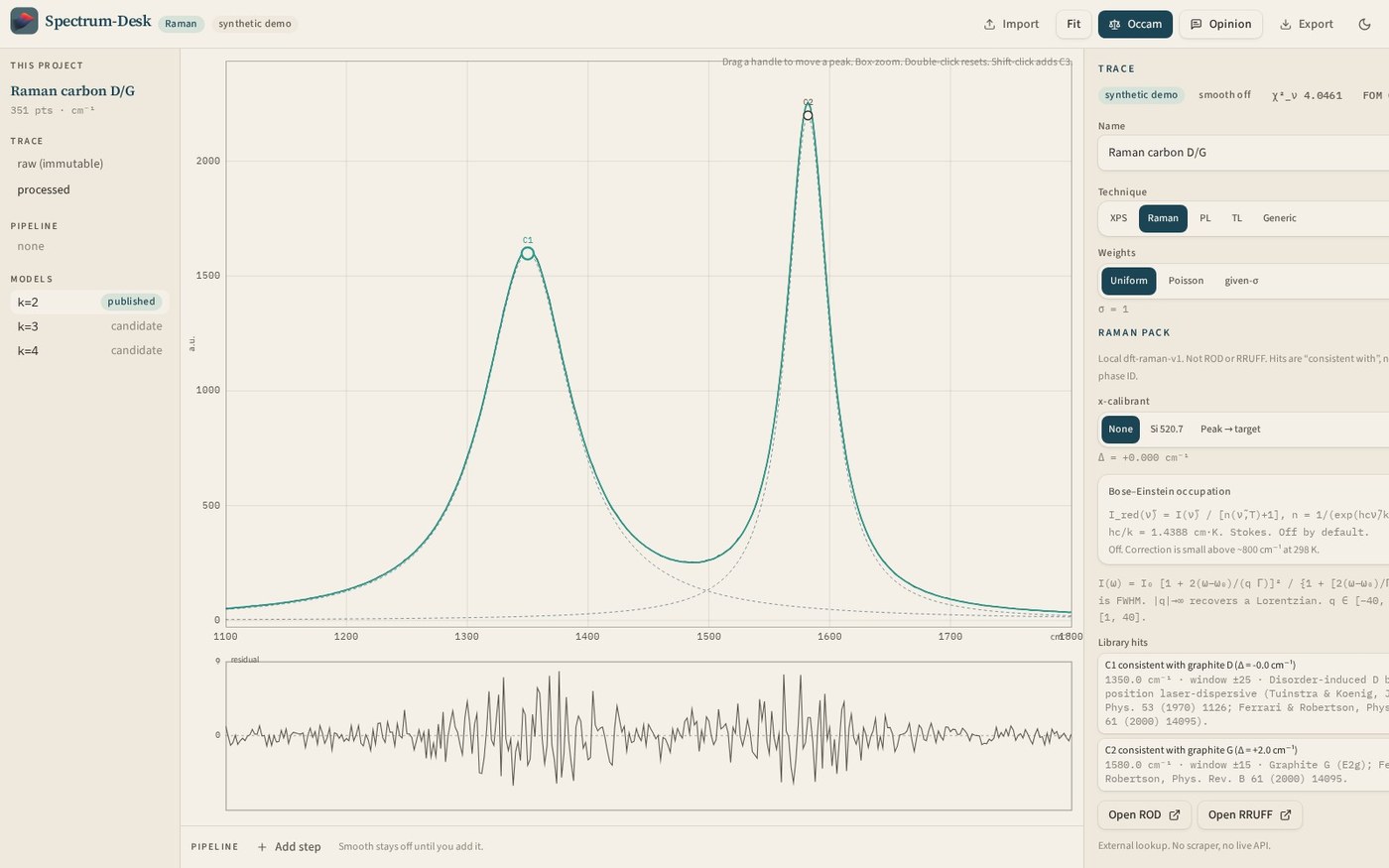
Spectrum Desk adds a component only when the lineshape is still physical and a simpler model is not the better description. XPS requires typed doublets, charge referencing, Tougaard backgrounds, and Scofield atomic percentages. Raman defaults to a Lorentzian and does not identify a phase. Photoluminescence treats an Urbach tail as its own component, not as a stack of Gaussians. Thermoluminescence uses Kitis glow-curve deconvolution with E and s gated. Candidate models k, k+1, and k+2 are ranked by BIC. Library matches are reported as “consistent with.” The word assigned is not written from a peak list.